
Each wing features an exhibit for players to interact with. In the library, students can read about the printing press and learn about Joan of Arc.


As an elementary school student, I loved computer class for the video games our teachers worked into the curriculum. One game taught me typing skills. While we played, our teacher covered up our keyboards with orange, plastic slips that shrouded the keys, but when she wasn’t looking, I would lift the slip to peek underneath, giving me an edge over the other students on the leaderboard. Playing these games, and the competition that spawned from them, gripped me much more than sitting in a classroom, listening to a teacher drone about math and geography.
Adventure Academy takes these types of learning games and presents them within the context of an MMO. You still practice your typing skills, read in-game books, expand your vocabulary, and solve basic math problems, but you experience all this within the context of an MMO developed by Age of Learning, the team behind ABCmouse. We spent some time with the game’s beta learning about Beowulf and Joan of Arc while exploring a charming 3D campus.
Each wing features an exhibit for players to interact with. In the library, students can read about the printing press and learn about Joan of Arc.
Character creators are part and parcel of many games today, but its inclusion in an educational game might feel novel to a third grader. After sculpting a Lara Croft-inspired character with brown pants and a long braid, the game dropped me into the titular academy. You’re encouraged to explore the campus, featuring wings for each major discipline: science, literature, history, and math. One thing kids will appreciate in Adventure Academy is that it allows them to focus on activities they enjoy. Don’t like math? You can read full-length books like Titanicat. Does history bore you? There’s a library of videos you can watch to learn science.
You participate in these activities by interacting with kiosks in each wing of the academy, and they take the form of simple flash games. I tried a number of games myself – they’re mechanically simple, and they don’t look as flashy as the game’s 3D world, but each one plays differently, which is another great way the game caters to different players. Some will like the drag-and-drop matching games while others enjoy Jeopardy-style vocabulary activities.

Most of the exploration-based quests we tried took the form of easy fetch quests, like this one that tasked us with planting trees in the garden.
A teacher oversees each area, and they issue you a variety of quests to explore on campus. Some take the form of fetch quests, like finding the missing finger bone of the T-Rex on display in the history wing or planting trees in a hidden mulch bed. One interesting quest asks players to locate pages of lore detailing the academy’s history, which are scattered around the building. While these quests were the type of mission I don’t like to see in MMOs, I think their inclusion might excite kids the most. Other players mill about completing quests, and there’s an in-game chat feature that third-grade-Hunter would have loved to use in a classroom. My best friend Jimmy’s assigned seat is across the classroom? Ha! I’ll just message him on Adventure Academy!
I expect the game to be some players’ first exposure to video game progression systems. You earn experience for completing each activity, and new quests open when you level up, as well as entirely new areas for kids to explore. New wardrobe options, like butterfly wings, backpacks, academy-branded sweaters, and infinity scarves, unlock at higher levels, which are incentives for kids to complete the game’s more educational activities at the kiosks. I was thrilled to see I could unlock a sword for my Lara Croft-themed avatar, and I know with certainty that, in elementary school, I would have obsessed over earning new cosmetic items long after class time.

Cosmetic items get more unique at higher levels. We saw top hats, cowboy hats, and every type of backpack in the marketplace.
While the bevy of unlockable cosmetics will stir competition within classrooms, I’m surprised Adventure Academy doesn’t include leaderboards for its skill-based games. The ability to rise through the ranks of your peers is a feature that lends itself naturally to a game that’s otherwise pretty social. Another head-scratcher is the decision to make the game download while kids play; traveling to new wings or hub spaces for the first-time requires long load times. These moments weren’t unbearable, but I imagine they could be for a teacher with a class of twenty students who just want to play the game. I’m curious to see if players can download the game entirely at launch instead of having to confront these first-time loading screens.
Gripes aside, I think Adventure Academy has the potential to be a great educational tool for classrooms or a fun kid-friendly MMO that parents could introduce to their children. There’s course material for every type of student – from the bookworm to the kid who just wants to earn a bunch of experience watching science videos. Adventure Academy launches on May 1 for PC and on Android and iOS devices. You can purchase a monthly subscription for $9.99 or an annual subscription that comes out to less than $5 per month when you pay up front.
Many of our editors at Game Informer are parents themselves. Read Javy’s column on what it’s like to be a gaming parent in a gaming world, or Matt Miller’s column on great tabletop games to play with your kids.

One year for my brother’s birthday, I logged into Runescape right after school, scouring for ingredients to bake him a virtual cake. We met up in-game that night so I could give it to him, and he loved it. I was thankful that we could enjoy the game and his birthday together, since we lived in different homes. I only got to see him every other weekend, but one of the meaningful ways we bonded was through Runescape and its seasonal events. I look back on these days fondly, because today, we no longer play together, let alone talk.
In college, I came out to my friends and family. Most people accepted me when I told them I was gay. My brother didn’t. He hasn’t spoken to me since. Sometimes it’s painful to remember our adventures online, knowing they may never happen again, but I’ve learned to cope with his decision. Still, I wonder how his perception might have been different if Runescape had recognized Pride the same way it recognized Christmas, Easter, and Halloween with festive, in-game events.
I don’t log into Runescape anymore; today, I celebrate my favorite holidays in Overwatch. I pour a haunting amount of time into its annual Halloween Terror event, earning spooky skins and sprays and participating in the co-op mode Junkenstein’s Revenge. For Christmas, I show off as Mei in snowball-fight arenas and explore a bevy of maps that get delightful, candy-cane-colored facelifts. There’s even an event for the Chinese New Year, where capture the flag maps boast colorful firework displays and certain characters get beautiful, ornamental outfits. In-game seasonal events are one of my favorite ways to celebrate the holidays.

Seasonal events, like Overwatch’s Halloween Terror, are great ways for developers to rope back in players who’ve moved onto other games.
Seasonal events brought my brother and I together when we were younger, but once I reached high school, our Runescape binge sessions ended. All that kept us coming back once or twice a year were the holidays. We’d drop whatever games we were playing to dress up as skeletons and trick-or-treat around Port Sarim. His parents, my mother and step-father, prohibited my brother from celebrating Halloween because of their religious practice, which wildly contrasted the home I grew up in. It frustrated me that I couldn’t experience that with my brother, but celebrating with him in Runescape was a worthy consolation.
Runescape’s seasonal events had such a big impact on us, and I often wonder: what would Pride have been like if we had experienced it together virtually? Pride is a celebration of the LGBT+ community that occurs on the anniversary of 1969’s Stonewall Riots in New York. The riots famously propelled the agenda for queer people to obtain equal rights, and today we remember the event with Pride parades, typically in June or July, all around the world. There weren’t any Pride events in the small town my family raised me in nor the rural community where I went to college, but seeing myself – a gay man – represented in the news every year during Pride season always made me feel more visible and validated.

Photo by InSapphoWeTrust / CC BY-SA 2.0
On the morning of Saturday, June 28, 1969, police raided New York’s Stonewall Inn to arrest patrons on the grounds of sexual orientation, which quickly escalated into a riot.
Pride isn’t just for people like me, though. Millions of people attend both local and national pride observations, like the crowd of 3.5 million attendees at 2017’s WorldPride in Madrid or the 2.1 million people who attended New York City’s 2016 parade. These events draw such huge crowds because Pride isn’t just for queer people – it’s for everyone. It’s about celebrating one’s identity just as much as it’s about embracing one’s sexual orientation.
It’s curious, then, that despite its wide appeal and its invitation to all people, developers don’t consider Pride when planning their in-game seasonal content. It’s a holiday that can be represented in just about any type of game, after all. Games with skins, like Overwatch, could offer popsicle-colored cosmetic items to represent the gaudy, colorful costumes that Pride paraders adorn in the streets. Imagine Overwatch’s payload maps festooned in rainbow colors the way the team redecorates King’s Row during the annual Winter Wonderland event. Replacing the banner in its capture the flag mode with a rainbow streamer would be an easy way for Blizzard to celebrate the holiday, too.

Pride costumes are colorful and exuberant and would lend themselves well as skins for seasonal events, just like the skins players unlock in Overwatch’s Winter Wonderland.
It’s easy to use Overwatch as an example here – the diverse roster of playable characters is a major feature that attracts the game’s millions of players, including two leading gay heroes Tracer and Solider: 76. But a developer doesn’t need a Blizzard-sized wallet to observe the holiday. Sea of Thieves developer Rare recognized Pride last year with the simple addition of a rainbow flag that players could fly from their ships’ mastheads. Its inclusion was just as meaningful as any full-fledged in-game celebration or game mode would be in Overwatch. Flags already existed in Sea of Thieves, too, so to add the item probably required short work from a single artist. And yet, the impact it had was huge:
10-yr old came racing up from the basement: “I’m playing a game called ‘Sea of Thieves.’ You know what? You can make your ship flag be the Pride flag! That’s so cool!” *tears off to the basement again*#ProudDad
— Jay Guevara (#CommitCuriosity) (@DrJayDrNo) June 15, 2018
hey @SeaOfThieves ? Thank you for putting the pride flag in your game. Truly means a lot to me. pic.twitter.com/0jFyzSeC0q
— Wow, Lesbian! (@zetabaeta) June 15, 2018
My pirate trolls and I had a particularly successful evening on @SeaOfThieves last night, culminating in us finally docking at base, our Pride flag resplendent in the sea breeze. 🏳️🌈 pic.twitter.com/TE9bqQwO5D
— Mike Thompson (@AppSecBloke) August 18, 2018
Picture just about any game, and you could probably fit Pride within its scope. Epic could easily create new voguing or death drop dance emotes for Fortnite. Niantic could plan special community days in Pokémon GO for major Pride observances that offer shiny Pokémon. (The legendary rainbow Pokémon Ho-Oh would be a suitable prize for participants.) These features are small asks: they don’t require developers to invest in entirely new mechanics or systems, only to utilize the tools they already have.

EDM superstar Marshmello recently hosted a full-fledged concert in Fortnite, turning Pleasant Park into a phantasmagoria of flashing lights and pulse-pounding beat drops. Is a Pride celebration really such a stretch?
While these ideas may sound simple, their inclusion’s importance can’t be overstated. Representation in games, movies, or any medium has an incredible impact on how we understand and engage with diverse people in the real world. Within the LGBT+ community specifically, the lack of leading gay characters in entertainment keeps our community shrouded in stereotypes and generalizations, to great and terrible effect: gay youth are five times as likely to have attempted suicide than their heterosexual counterparts, and LGBT+ people are roughly twice as likely to develop depression and anxiety.
I can see why including a holiday steeped in social issues might seem risky to a developer: The dark side of the internet is sure to call it “pandering,” and rude players will certainly find a way to react in toxic fashion to any sort of in-game observance. Toxicity toward minorities is something that would have to be closely moderated and controlled; it could even take away from the positivity of the event if handled poorly. I hope that developers don’t dismiss the idea of recognizing Pride in lieu of toxicity, though. It’s visibility, after all, that changes public perception of disenfranchised groups for the better.
I’ve celebrated every major holiday in my favorite games, but not Pride. There’s a good case for developers to observe the event within the scope of their games, considering Pride is a widespread celebration in the real world, and that it’s a holiday that invites anyone to participate. I know it would have real social impact, too, with how mainstream video games have become. How would society’s treatment of LGBT+ people change if we used games as a medium to engage with that community? It wasn’t easy growing up gay in a small town. If I, or maybe even my brother, had seen Pride in Runescape back in middle school, it would have made a world of difference.
We’re slowly seeing more LGBT representation in games. Respawn recently revealed that some of its Apex Legends heroes identify as LGBT+. Similarly, Naughty Dog made a big statement during its gameplay reveal for The Last of Us Part II at E3 2018, which shows Ellie in a romantic relationship with another female character.

Level editors are my favorite endgame destination. I appreciate the highly curated experiences developers create – the easy-to-read level design, or the fine-tuned balance in multiplayer maps – but after I’ve experienced a game the way its developers intended, level editors provide a fun incentive to stick around. They’re often quite educational, too, making me realize the incredible effort that goes into building and polishing my favorite game worlds.
With a level builder on the horizon for Super Smash Bros. Ultimate (wahoo!) and PS4 game creation tool Dreams in early access, it’s an exciting time for fans of building games. While we wait, here are some of the coolest level editors I’ve seen in games.

At this point, Fortnite’s Creative Mode isn’t just a traditional map editor – it’s a full-fledged game creator. Using the title’s full suite of level-editing tools, players can create everything from medieval castle-themed escape rooms to zombie survival missions modeled after Call of Duty maps. Fortnite celebrates its community of creative players in a unique way, too – developer Epic Games selects the most impressive player creations and features them on a dedicated lot in its Battle Royale mode. Unfortunately, they’re not always to good taste.
Click here to watch embedded media
Unlike most level editors, which are mere bonus features, Nintendo released Super Mario Maker as a standalone title, allowing players to create their own Super Mario platforming courses in both the classic 8-bit and 16-bit aesthetic as well as the modern glossy look of New Super Mario Bros. U. The level editor utilized the WiiU and 3DS’ touch controls to offer an accessible, user-friendly building experience. It’s not too late to build your dream Mario challenge, though! Nintendo is working on Super Mario Maker 2 for Switch, due out this summer.

Since Far Cry 2, every game in the series has featured a map editor, but the latest numbered entry shook things up with a couple game-changing additions. For the first time, players could create custom mission types, instead of building a map and choosing from pre-created game modes. What’s more, players weren’t limited to just Far Cry 5’s assets – they could populate their worlds with objects and imagery from a multitude of other Ubisoft properties, including Watch Dogs and several Assassin’s Creed games.
Click here to watch embedded media
Skateboarding games have had map editors since the ‘90s, letting players build their dream park and set up their gnarliest grinds – and wipeouts. However Skate 3’s list of features set it apart from earlier skating games: Players could design their own graphics and logos on the Skate website, then import them into the game to adorn their skateboards, parks, and outfits. Additionally, a unique camera feature allowed players to snap screenshots and produce videos of their skating sessions, then upload them to share with the community. We’re still holding out for Skate 4, but while you wait, check out our replay of Skate 3 above.

LittleBigPlanet’s story mode is charming and respectable as a puzzle platformer, but it’s the series’ level creation tools that really gave each game legs. Between LittleBigPlanet 1 and 2 alone, users shared more than 7 million levels. LittleBigPlanet 3 gave us the most comprehensive suite of tools in the series, including the ability to manipulate the world on sixteen different depth levels. What’s more, Create Mode introduced players to “Popit Puzzle” levels; instead of forcing players to watch long tutorial videos, these levels taught the level editor’s tools by way of puzzles for players to solve.

Spore had a lot of big ideas. The game took place over the course of five phases, each with a radically different type of gameplay, following a species’ evolution from pond scum to space explorers. One feature fans requested most when the game launched was the ability to leave their spaceship during the game’s final phase and go on planetside adventures. Developer Maxis listened with Spore Galactic Adventures, a massive expansion that added the comprehensive Adventure Creator. This level editor, like certain parts of the base game, allowed players to create most of their own assets from scratch – from doorways to spaceships – in addition to offering a full library of audio and visual effects to add to player-created scripted missions.
I’d love to see more level editors in games. They’re great tools for players to exercise their creative muscles the same way developers do, and the creations that come from fans highlight the best parts of online communities. While you wait for that Super Mario Maker sequel, check out this list of custom levels built by the Game Informer staff. Here are some games we wish had level builders.

The Walking Dead revels in moral ambiguity. Each episode introduced us to new characters, giving us just enough time to love them (or hate them) before putting us in charge of their fates. Choice is often an illusion in Telltale games – characters’ destinies often stay the same regardless of your choices in critical plot moments – however, the studio succeeded in making each decision feel weighty and impossible.
The final episode launched in late March, and Clementine’s story is over (see how Clem’s voice actress reacted to the finale here). So it’s a great time to reminisce about the series’ most gutting decisions. Spoilers below, folks!

The final decision in Starved For Help comes after a traumatic episode for Lee and Clementine: their starving group takes shelter at a farm where they discover that “human” is an entrée. After surviving the cannibals, they stumble across a car parked ominously in the road. The lights are on, the keys are in the ignition, and the trunk is full of supplies. Players can choose to steal the supplies for themselves or leave them for the person they belong to, putting you in a dilemma where you must weigh the needs of your group against the needs of a stranger who may not even be alive. Regardless of Lee’s decision, the group loots the car, catalyzing a chain of events that results in Clementine’s kidnapping in the season finale.
The supplies, it turns out, belonged to a husband and wife who left their car on the street for a few minutes while they searched for their missing son in the woods. It’s a great setup for one of The Walking Dead’s best guilt trips.

In Season 2, Clementine and Jane scavenge for supplies that might help them deliver Rebecca’s overdue baby. It seems like a miracle when, out of nowhere, a crippled boy named Arvo crosses their path with a bag full of medicine. Arvo says the medicine belongs to his sister, but Jane sees holes in his story, so Clem must choose whether or not to steal the supplies for their own group.
It was tough having to weigh Arvo’s unknown circumstances against Rebecca’s impending delivery, but your decision – in classic Telltale fashion – ultimately makes little difference on the outcome: Rebecca dies shortly after childbirth, and when the group encounters Arvo again (this time with friends!), the scuffle between him and Jane results in a firefight between both groups.

Clem has a hard go of making friends at the beginning of season two. After a dog bites her, she stumbles across a new group of survivors who suspect that the bite is actually from a walker. Nick nearly shoots her, while his father, Pete, gives her the benefit of the doubt. If you had to choose which one to save just off that conversation, the decision would be simple, but the final scene makes everything a bit more complicated: Pete takes a walker bite to the leg while he, Nick, and Clem explore a nearby stream, and then a horde approaches.
Clementine has to make a choice. Is saving Pete at Nick’s expense a lost cause, considering he’s now infected? Or should she save Nick, who doesn’t really care for Clem that much in the first place? This scenario reminded us right out of the gate in season two that this is a series where no decision is black and white.

The Walking Dead got a major reset after season two, including a time jump and new characters: playable protagonist Javier, his brother David, and his sister-in-law Kate. David goes missing during the early days of the outbreak, so Javi and Kate group up and, well… the hokey pokey still happens in the zombie apocalypse.
In the season’s penultimate episode, after David comes back into the picture, Kate confesses her love for Javi, and players are given the option of slapping a label on it at the risk of damaging their relationship with David. Matters of the heart are always a hard call.

There are some serious stakes in the season three finale. A horde of walkers penetrates Richmond, and while Javi wrestles with choices that impact the future of the community, he’s also forced to make decisions regarding his family’s fate. Kate wants to help save Richmond from the walker threat, but David wants to take his son Gabe to shelter outside the city. Javi, of course, must make a choice.
If you choose to go with Kate, David dies (which isn’t the worst thing in the world if you shacked up with her in the previous episode). If you choose to go after David and Gabe, though, you’ll come back to Richmond to find your boo-thang zombified. It’s a sad day all around.

The Walking Dead felt familiar when its first episode debuted in 2012. It had dialogue trees that let you choose how kind or how sassy you wanted Lee to be. It had QTEs that added urgency to its scenes like other action games. But it was the season’s climax that earned the series its place in the pantheon of standout video game narratives, by way of a choice: Lee and his group of survivors are pinned in a convenience shop by an encroaching hoard, and for the first time in the series, the player’s actions directly determine the fates of your friends Carly and Doug. The novelty of the idea, that choosing one friend results in the death of the other, made this choice incredibly tough and affords it its place on this list.

This one is a doozy.
Lee and Clementine traveled with a friendly, bearded man in season one named Kenny who tragically loses his son to a walker bite and his wife to suicide. Kenny’s fate is uncertain at the end of the season when a mob of walkers separates him from the group. In season two, though, he reunites with Clementine at a ski lodge, but she can tell something in him has changed.
Clem’s arc in the second season also involves her relationship with Jane. She teaches Clementine how to safely take down walkers despite her size and how to loot them for supplies. Jane is a survivor, Clem learns, and those instincts put her at odds with Kenny, whose mental stability everyone is questioning throughout the season.
In the final episode, the group is gone, and the only people who remain are Clem, baby AJ, Kenny, and Jane. Kenny becomes aggressive, and he and Jane engage in a brutal brawl while Clementine stands to the side. At one point, Clem picks up a gun. She can shoot Kenny, her longtime friend, or not intervene, allowing Kenny to kill Jane. It’s one of the series’ decisions that causes the most second-guessing after you make your call.

Each of these decisions pales in comparison to those you’re forced to make in The Walking Dead’s final season, because the brunt of them involve a subject no one finds easy: parenting. Clem makes decisions throughout the season that we’re told impact the type of man AJ will grow up to become. Low impact decisions – like whether or not you’ll let AJ start swearing – don’t carry much influence over the course of the season, but some scenarios, like the opening to Broken Toys, do.
A group of bandits attack Clem’s home, and she and her friends takes a grunt named Abel prisoner. Players must interrogate him while AJ observes, adding extra weight to choices you make. Will you be the good cop and risk not learning valuable information? Or will you play bad cop – beating Abel’s head against a desk or burning his cheek with a lit cigarette – and risk AJ becoming more violent? This scene is a reminder nobody needed: Parenting is hard!

You can attribute a lot of The Walking Dead’s success – the first season won Game of the Year in 2012 at the Spike Video Game Awards – to its emotional season-one finale. A walker bites Lee, and in one decision, players choose whether or not they’ll amputate his infected arm to try and save him. Either choice is futile, because the infection has already spread too far. You can’t save Lee.
In the season’s final scene, Lee gives Clementine a choice: shoot him, or leave him to turn. In-game statistics show that the majority of players choose to kill Lee, so while the decision isn’t very divisive, it still draws on the intense emotions players develop for the two characters throughout the season, making it one of The Walking Dead’s hardest choices.
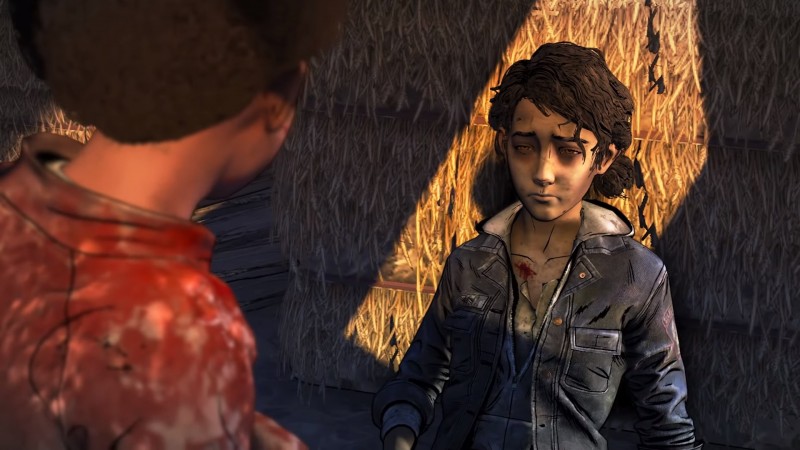
Choosing whether or not to kill Lee is a cakewalk scenario compared to the series’ final choice. As they scuffle up a rock wall to escape a group of walkers, one sinks its teeth into Clementine’s lower leg. The zombies are closing in, and there’s no time to amputate it, so Clem and AJ are forced to ignore the bite until, finally, they find shelter in a nearby barn.
The game puts players in control of AJ now, and mirroring the scene between Lee and Clem in the season one finale, Clem gives AJ a choice: kill her or let her turn. Why is this scenario harder than the scene that inspired it? Because instead of a gun, the only weapon AJ can use is the axe… The moment carries incredible weight, forcing players to decide the fate of a character they’ve watched evolve in-game for seven years. After you give AJ your order, though, he makes his own choice: He cuts off Clementine’s leg, despite your decision. She survives. The Walking Dead, shockingly, gets a happy ending.
Were there any choices you struggled with throughout the series? Let us know your decision hottakes below. Make sure you read our interview with Clementine voice actress Melissa Hutchison, where she tells us how she reacted to the final episode. You can check out our review of the final season here.

Seven years ago, veteran voice actress Melissa Hutchison landed a role as Clementine in Telltale Games’ The Walking Dead. She couldn’t have known at the time that the first season of the episodic adventure series would launch to great reviews or that her character, who wasn’t even playable in the first season, would go on to become the face of the series. Now, the final chapter is out and Clementine’s story has reached its conclusion. We spoke with Hutchison about her wild and unpredictable journey as Clem, her emotional reaction to the game’s final episode, and the untimely closure of Telltale Games.
Full spoilers below for the entirety of Telltale Games’ The Walking Dead series.

Voice actress Melissa Hutchison recording dialogue in the VO booth.
In The Walking Dead’s inaugural season, players took on the role of Lee, an ex-con who crosses paths with an orphaned girl named Clementine in the early days of the zombie apocalypse. Lee acted as a father figure to Clem throughout the season, which made its finale as emotional as it was shocking: Lee, bitten by a walker, asks Clementine to decide whether or not to kill him before he turns into a zombie himself. The result is the same whatever players decide to do. Lee dies, and in a twist, Clementine – and Melissa Hutchison – becomes the series’ lead.
Hutchison never knew this was the plan, though.
“The creatives didn’t even have [Clementine being the series protagonist] in mind,” Hutchison says. “I don’t even know if they intended to do a second season.”
It wasn’t until the reviews and accolades started rolling in that Hutchison realized she’d lent her voice to a hit. Critics hailed the series as a revitalization of the adventure-game genre, and at the 2012 Spike Video Game Awards, not only did the first season win Game of the Year, but Hutchison also took home the trophy for Best Performance by a Human Female.
“Then it all started to make sense… I had no idea that we would be sitting here at this moment, so many years later, wrapping it all up.”

In The Walking Dead’s debut season, players controlled Lee, acting as a fatherly figure to Clementine while the pair searched for her missing parents.
“As for Clementine being the playable character, I did not know until about a month before going in to record season two,” Hutchison says. “Season three was a little bit of the same situation. I had no idea what they were going to do with it. I wasn’t even sure if there was going to be a season three.”
The series didn’t have a definitive path from the beginning, according to Hutchison. The creatives at Telltale Games conceived each season ad hoc, so while Clementine ended up being the series’ emotional through line, Hutchison says she went into each episode not knowing if her character would come out alive.
“I don’t think I found out for sure if she was going to live or die until we started recording the final episode,” says Hutchison. “Personally, I had a feeling that they weren’t going to kill her, but I knew something horrible, at least, had to happen.”

Her hunch proved accurate. In The Walking Dead’s final episode, Clementine takes a walker bite to the leg. It’s a horrifying moment for longtime fans that’s made more gut-punching by the fact that her foster kid, AJ, watches it happen.
Clem and AJ hole up in a rundown barn from a walker horde where she collapses from fatigue. The infection is killing her body. Suddenly, the game changes perspective, putting players in control of AJ for the first time, and the two engage in one of the most somber, tearful scenes in the entire series.
The Walking Dead is a game about choice and consequence, and players spend most of the final season making hard calls about how to raise AJ in a world ravaged by death and murder. In one of the final choices in the game, players decide whether they’ll kill Clementine before she can turn into a walker or leave her in the barn to turn. The scene parallels Lee and Clementine’s final exchange in season one. In a twist, AJ makes his own choice, regardless of what players tell him to do: he axes off her bitten leg, and with it, the infection. Clementine survives.
“I didn’t know the ultimate outcome of the final episode until literally going in to record it,” Hutchison says. “I didn’t want to know. The director was kind of on board with that, too… He wanted the Barbara Walters moment, if you will, in the performance.”
Click here to watch embedded media
Hutchison says she is satisfied with Clementine’s fate, despite the fact that The Walking Dead TV and comic series’ are notorious for killing off nearly every main character, to the degree that some might call it a rite of passage.
“I think it’s really honoring the fans, ultimately, that they decided to keep her alive,” Hutchison says. “The love is very strong in this fanbase. These are just my theories, but I think the writers felt like if they killed her, it was doing a disservice to the [fans] who have literally driven this game. If not for the strength and love of this fanbase, it wouldn’t have been worth saving. I think the writers were honoring the fans in keeping her alive.”

In late September 2018, Hutchison went to the studio to record dialogue for the final episode of The Walking Dead. Director Jack Fletcher wanted her to record Clem’s “death” scene in the barn, and a later moment where Clem confesses doubt in her ability to make choices for AJ. They were incredibly emotional scenes for Hutchison.
What she didn’t know was that while she recorded her dialogue, more than 200 employees received fateful news: Telltale Games was shutting down. They were laid off, effective immediately. Each developer would receive a paper paycheck with pay through the end of the day. They had 30 minutes to leave the building. 200 creatives’ futures were now up in the air – and so was Clementine’s.
“I was like, holy s—, this is the worst goodbye to a character ever,” Hutchison says. “It felt so incomplete, and it felt horrible.”
— The Walking Dead Game (@telltalegames) September 21, 2018
This wasn’t the end of Hutchison and Clem’s journey, though. In October 2018, developer Skybound Games – founded by The Walking Dead creator Robert Kirkman – announced it would take over The Walking Dead’s development and publishing, working with members of the original Telltale team to wrap up Clementine’s story. They called themselves the Still Not Bitten crew – a name that not only expressed Clem’s resilience against the walker threat but the developers’ commitment to finishing Telltale’s crowning project. Hutchison returned alongside them, thankful that the scenes she’d recorded the day of the layoffs needed little alteration.
“At least a couple months later, after Skybound had picked it up and we got back in the studio, it was kind of good [that we’d finished those scenes], because I didn’t have to relive a lot of the emotional stuff from the day the company shut down,” Hutchison says.
Skybound retained Telltale’s vision for the final two episodes, according to the actress, who only had to make minor changes to Clementine’s dialogue after development switched hands. The major plot points stayed the same.
“It’s not like Telltale wrote [Clementine] to die, and then Skybound said, ‘She’s going to live!’” Hutchison says. “Which is really cool, and that was the only way I was going to feel good about picking up and continuing.”

Just as Clementine has evolved from a scared little girl trapped in a treehouse to one of gaming’s most recognizable heroines, Hutchison’s gone through her own transitions in the last eight years. Her work as Clementine opened doors for her that led her to land more narrative-heavy roles, such as Beauty in The Wolf Among Us and Isa in Minecraft: Story Mode. She’s started working more in animation, too, with credits in shows such as Space Racers and Yo-kai Watch.
“I don’t ever want to say there will never be an experience like this again,” Hutchison says, “…because games are so cinematic now and there are many options [for an actress] for that kind of character growth. But you know, it’s been such an amazing experience. The whole experience feels almost like an amazing dream…”
She’s finished recording dialogue, but Hutchison doesn’t feel like the experience is over just yet.
“I definitely feel, once it’s settled, and I’m done messaging people and showing my gratitude… I have a feeling I’m definitely going to sink into an ‘oh s—, I don’t get to be Clementine anymore!’ mindset,” Hutchison says. “She would have been great as an 18-year-old! She would have been great as a 24-year-old. But she’s alive. I’ll take it.”

Unlike some voice actors, Hutchison is a huge fan of the games she performs in.
Several times during our call, Hutchison emphasizes how grateful she feels to have had the opportunity to work on The Walking Dead. It’s palpable when she recounts working with the “brilliant” developers, or when she remembers the choices she made when she played through each episode as a fan, or when she talks about the great friendships she’s made through Telltale.
“I feel, just ultimately right now, so much gratitude. I feel full. With the completion of this season, with this game, that I am in a really solid place with Clementine right now and she will forever be this precious experience of my life like none other.”
You can read our thoughts on The Walking Dead’s final season here. Here’s a feature we ran back when the series debuted in 2012 on how Hutchison built Clementine’s voice.

In its 20-year history, developer Eko Software has experimented with a number of genres. Its catalog of nearly three dozen games includes endless runners, sports titles, top-down shooters, and puzzle platformers – and now the studio is once more trying something new with Warhammer: Chaosbane, its first loot-centric hack n’ slash game, set in the Warhammer fantasy universe. I had a chance to play the private beta, experimenting with its deep loot and progression systems, dabbling with online multiplayer, and learning the nuances of two of the game’s four playable characters.
Warhammer: Chaosbane is an isometric action/RPG that feels immediately familiar to anyone who’s played a Diablo game. In both games, you and some friends explore twisted dungeons, cut swaths through hordes of demons, collect and equip loot to enable you to defeat tougher enemies, and repeat. Character progression is at the center of both games but Chaosbane sets itself apart with its Warhammer title. It’s set in the long-running Warhammer fantasy universe, which spans novels, tabletop RPGs, and video games, so Chaosbane’s world, and the forces of Chaos that threaten it, are a treat for franchise fans.

To fight back against the Chaos hordes, players start the game by choosing from one of four character classes – Konrad Vollen is the Imperial Soldier whose abilities emphasize close-quarters gameplay; Prince Elontir is the High Elf Mage whose arcane powers – ranging from hurling fireballs to calling down bolts of ethereal lightning on foes – encourage ranged attacks; Bragi Axebiter and Elessa are the Slayer and Wood Elf Scout classes, respectively, although they were locked during the private beta. Each character has their own backstory, but character development ends after the game’s expository opening cutscenes, taking a backseat to Chaosbane’s moment-to-moment gameplay. It’ll be interesting to see if each of these characters changes throughout the game’s campaign.
Click image thumbnails to view larger version


Chaosbane’s plot stays the same for each of the classes you can choose from: Your character serves Magnus, a soldier who has united the world’s warring factions and leads the fight against Chaos. At the beginning of the game, a sorceress puts Magnus under a curse, and players are tasked with tracking her down in order to reverse it. You complete the same missions regardless of which class you chose at the start, a design decision that supports the game’s multiplayer (see sidebar). In the game’s early hours, your task is to exterminate a cult that’s set up shop in the sewers beneath the city. There is plenty of enemy variety here: swarms of gremlin-like creatures dance around you like flies, often serving as distractions from slower, heavier-hitting enemies that lumber out of the shadows. Just as combat begins to feel comfortable, a mission doles out new enemy types that made me sweat a little and forced me to try out new attack combinations.

Harder enemies, like a large Cthulhu-inspired sewer monster that spits poison gunk at you, require dodging out of the line of fire. Without a designated dodge mechanic, though, these enemies aren’t as fun to encounter; with so many enemies on screen, it’s easy to accidentally click a bad guy instead of an empty space, leading to a handful of deaths when I couldn’t move out of harm’s way. This is a minor grievance, but it occurred more frequently the longer I played, as the game pits you against increasingly larger hordes of enemies.

While the plot and missions you embark on remain the same for each character, both classes I played had enough nuance in their skill trees that made starting over with a new character feel worthwhile. Prince Elontir, whose passive ability allows you to guide a ball of damage-dealing mana with your mouse, played very differently from Konrad Vollen, who baits enemies into close-quarters with an ability that increases damage within a certain radius around him. I’m excited to see if both the Slayer and Wood Elf Scouts offer experiences unique from each other, as well.
There are more than 180 skills to mix and match in Chaosbane, but the number of skills you can have active at a given time is locked to your character’s level. At first, we made Prince Elontir a jack-of-all-trades magician, kitting him with a mixture of low-level elemental spells, but once we’d unlocked a few stronger versions of spells, we replaced a few of our weaker abilities with a high-level fire power. High-level spells require more skill points to equip, and your character has an exhaustible number of skill points to allocate, so choosing which spells to equip and which to bench is always a hard choice.

Chaosbane’s skill trees and character progression are deeply tied to its loot systems. Just like in Diablo, there’s a lot of loot in this game, which you find in chests and enemy corpses as you explore dungeons. I expected to find item sets, which you typically expect from a loot-centric game, but I didn’t come across any during my time in the beta. Each piece of gear does have its own unique attributes, though, like ability cooldown reduction and increased drop rate for high quality gear, that offer a healthy variability in customization. You need to equip your best items early and often: even in just five hours of play, the difficulty ramped up significantly, so making sure I had the best loot equipped before and during missions became a critical part of my gameplay loop.
That said, inventory management isn’t always breezy. New items are starred on the inventory screen, and while there’s a handy feature that allows you to compare highlighted gear to your currently equipped gear, the interface frustratingly lacked an option to organize loot by type.
After a few hours of play, I felt that cutting through hordes of enemies in the sewers, gathering loot, and speccing out my characters was fun… but it started to feel easy. So easy that I didn’t really have to think about numbers as I made progression and gear choices.
That’s when we realized I was playing on normal mode.
Chaosbane offers nine levels of difficulty, and normal is third from the easiest. Higher difficulty levels were locked for the beta, but for fun, I kicked it up one notch from normal to hard. The spike in challenge is significant. Smaller enemies hit harder, and mini-bosses feel like actual threats. It’ll be fun to play the game when those higher difficulty levels are unlocked, where paying attention to stats and skills will likely reward numbers-focused players.

For a studio that’s never developed a loot-based dungeon crawler before, Chaosbane’s beta is a strong indication that Eko Software is prepared to take on the challenge. I enjoyed its progression grind, and I expect to spend dozens more hours experimenting with new gear and abilities once the full game is available.
Warhammer: Chaosbane launches on June 4 for PS4, Xbox One, and PC. If you need something to scratch your itch for monster-hacking and loot-snatching, Blizzard just re-released an upgraded version of the original Diablo on PC. Last year, the company revealed Diablo Immortal, a sequel to Diablo III for mobile devices. Blizzard hasn’t announced a release date yet.

Lara Croft has tromped, pillaged, and plundered dozens of ancient temples and dusty crypts in her 20-year history. They’re often stunning places: palaces perched atop steep mountains or sunken beneath icy glaciers, inhabited by exotic birds and sneaky monkeys (and sometimes dinosaurs). Standing in one place to gawk at these lovingly crafted worlds can be deadly, though. As developers have pushed graphical performance further and further with each new entry, so too have they iterated on the traps and mechanisms that put Lara in her grave.
Here are some of the Tomb Raider series’ deadliest tombs – the levels that challenged our platforming prowess or had our palms sweating as we walked carefully through blood-tinged spikes and battled quickly dwindling breath meters.
Click here to watch embedded media
The level starts underwater. The mini-sub Lara hijacked has crashed into the sea floor, her breath meter is draining, and sharks circle around her. The player’s goal is to reach a sunken cruise ship, but thanks to some poor, late-‘90s draw distance, it’s unclear which direction players should swim into the surrounding blackness, save for an obscure trail of ship debris on the seabed dotting a subtle path toward the boat. It’s a far cry from typical Tomb Raider level intros that typically open with a stunning view before forcing Lara through a gauntlet of traps and puzzles.
The level doesn’t get easier. If players can avoid being shark bait and find the easy-to-miss ship entrance, they’ll have to sink some ammo into the shotgun-wielding cultists roaming the corridors, hunt barracudas slithering in shallow pools, and avoid catching fire from faulty ship tech. (How this vessel still has functional tech in the first place is beyond us.)
Click here to watch embedded media
This level has it all: grand spectacle, trap-laden puzzles, bloodthirsty exotic animals – even an Indiana Jones-inspired boulder trap! Lara travels to St. Francis Folly in Greece looking for a piece of an ancient artifact but gets a lot more than she bargained for.
The brunt of this level involves leaping and dangling from a series of platforms pillaring up the center of a multi-storied chamber. To explore deeper, Lara needs to survive a sequence of combat and platforming challenges across four rooms connected to the central hub – each themed after certain gods. Navigating to each room is a challenge in and of itself, but the true difficulty resides in each room’s traps. The Thor-themed chamber requires Lara to stand under a massive, falling hammer, dodging out of the way at the last second. The Damocles chamber requires Lara to avoid swords that fall from the ceiling as she passes under them. The level is Tomb Raider at its best and most challenging: an evocative tomb as deadly as it is beautiful (especially the version remade for Tomb Raider: Anniversary.)
Click here to watch embedded media
In Lara’s PlayStation 2 debut, she’s on the run, framed for her mentor’s murder. Her quest to unravel the conspiracy and clear her name takes her to an archaeological dig underneath the Louvre, and deeper within, an ancient tomb called the Hall of Seasons.
The level evokes the design of St. Francis Folly in the way its central chamber branches off into four mini-levels that players need to conquer to continue down the main path. Deciding whether to bunny hop or perform medium or long-range jumps across swaying pillars in the Breath of Hades area is one of the series’ most difficult platforming challenges. Similarly, the area called Wrath of the Beast requires players to hurry across collapsing platforms before the floor gives out completely. It might not sound more difficult or challenging than other platformers you’ve probably played, but Lara’s controls were not as user-friendly in 2003 as they have been in recent years.
Click here to watch embedded media
Tomb Raider III’s opening level pulled out all the stops to prove to players that after two games, the series could still kick your butt. Jungle, set in monkey-infested ruins in India, starts with Lara sliding down a muddy ramp riddled with spikes and a boulder that will smoosh you if you stand in the wrong spot. Players encounter traps like these numerous times throughout the level, making every step and jump feel weighty and tense.
The real threat here isn’t the boulder traps or the spiky pitfalls, though: it’s the quicksand. A misplaced jump will send Lara into the mud, forcing players to watch as her body slowly sinks below the surface and her breath meter runs empty. Jungle remains one of the series’ biggest slaps in the face. Hey, look at our cool, new environments! And hey, everything wants to kill you!
Click here to watch embedded media
Crystal Dynamics’ second reboot of the Tomb Raider franchise gave us a version of Lara Croft that was more action hero than ever before, but the series was criticized for how its tombs and puzzles took a backseat to combat. Shadow of the Tomb Raider righted that, giving us a game front-loaded with some of the best puzzles and exploration in the series.
Howl of the Monkey Gods is one of these tombs, released post-launch as DLC. Traversing the ravine leading up to the tomb is perilous on its own, requiring Lara to make some tricky, timed jumps, but this is just a warm-up for the platforming to come. Inside the tomb, Lara needs to re-tune an ancient, massive musical device in order to cross its instruments and reach the treasure at the end of the room. Activating each part of the instrument requires players to find and press levers that are positioned over spike traps. It’s easy to tell when the spikes will pop up, but having to stand on them still elicits a feeling of dread.
Once the levers are all pressed, there’s still the matter of crossing the active instruments to snag the treasure on the other side, avoiding falling drum sticks and platforms that give way underneath you if you cross them at the wrong moment. Howl of the Monkey Gods is Tomb Raider puzzle design in its purest form: a cross section between evocative atmosphere, tricky platforming, lever-pulling, and near-death scenarios.
Ask anyone who’s played a Tomb Raider game, and they can probably tell you what traps killed them before they could tell you what artifact they were hunting, or why. In that regard, Shadow of the Tomb Raider was a return to form for the series, giving us tombs and traps that felt deadly again. With the game out and its post-launch DLC wrapping up, we can only hope that Lara’s next adventure dishes out just as much danger.

You’ve seen us play it. You’ve seen the roster so far. Now you can try Mortal Kombat 11 for yourself, in the upcoming closed beta.
U.S. players who purchase the game can access the beta beginning Wednesday, March 27 at 8 a.m. PST and ending Sunday March 31 at 11:59 p.m. PST. Pre-ordering also nets you Shao Kahn, the series’ notorious villain and emperor of Outworld who seeks to conquer every realm.
We recently spoke with two physicists about the plausibility of Mortal Kombat’s fatalities – including Scorpion’s classic spine rip. Also, check out our hands-on preview of Mortal Kombat 11’s story mode, which introduces time travel into the series’ outlandish plot.
[Source: Twitter]

Resident Evil 2 is a terrifying game. Your ammo stock is always teetering on empty, zombies you thought you killed reanimate (again) when you least expect them to, and there’s a menacing, fedora-wearing figure called Mr. X who hunts you through the corridors of Raccoon City’s police station. To classify this game as “horror” is an understatement.
Thankfully, several players have uploaded mods that make exploring Raccoon City a little less frightening. Here are some NexusMods that transform Resident Evil 2 from survival-horror to survival-comedy.
Click here to watch embedded media
We knew Mr. X packed a punch, but this mod by MisterHecks shows how much heat the Tyrant is packing. “Beachboy X” gets rid of your nemesis’ imposing trenchcoat and fedora, replacing them with slick shades and, ahem, a little umbrella.
Click here to watch embedded media
You knew it would happen eventually. This mod by ZombieAli swaps out Mr. X for Thomas the Train. For the full effect, we recommend using this mod in tandem with DJPop’s audio mod, which replaces Mr. X’s heavy footsteps with the whoosh of a chugging steam train and his default punch sound effect with the toot toot of Thomas’ whistle.
Click here to watch embedded media
Mr. X can be as annoying as he is menacing. As we mentioned in our review, puzzle solving can become a bit of a struggle with the Tyrant following you around like a stranger at a bar who can’t take a hint. We’re not sure if this mod makes matters worse. Mr. Squeaky X by Jewelson replaces the sound of Mr. X’s identifying footsteps with an effect that sounds like he’s walking around in slippers made of rubber ducks. Does it make him less frightening? Sure. But it also gives you extra incentive to keep as far away from him as possible.
Click here to watch embedded media
If Resident Evil 2’s zombies were hungry before, this next mod will make them thirsty. ToraNeko98’s Sexy Leon mod strips the protagonist down to a near-birthday suit, which isn’t the most practical apparel to protect you during the zombie apocalypse. The mod even gives him a shoulder tattoo that says “Rookie” to complement his RPD-branded beachwear.
Click here to watch embedded media
Ignorance is not always bliss. This mod by Crazy Potato turns all of Resident Evil 2’s enemies invisible, including bosses! You’ll still hear Lickers shifting across the ceiling and Mr. X’s heavy (or squeaky) footsteps growing louder, but sound is now the only sense you can use to survive the night. (Pro tip: if you set enemies on fire, the flames will indicate a zombie’s location, helping you avoid them as you do your mad dash through the police station.)
Click here to watch embedded media
Resident Evil 2 added free DLC last month that lets you play as Tofu, a literal block of knife-wielding bean curd. If you love Tofu so much, and one just isn’t enough, Snipzu’s Tofu Zombies mod turns all enemies into big blocks of mashed soybeans. For as funny as this mod is, it presents an interesting challenge to gameplay: how do you perform headshots? Do tofu have heads? We don’t know!
Click here to watch embedded media
The funny part of this list is over now, because this next mod sounds like a straight-up nightmare. Zealot Tormunds, a user on the Resident Evil modding forum, created a mod that replaces almost every enemy in the game with Mr. X. Tormunds suggests using flash grenades to assist in skirting large hordes of X but isn’t certain if the game is beatable with the mod installed. Actually, that is kinda funny.
We love Resident Evil 2, and so do many others, as the game’s already shipped more than four million copies. Check out Kimberley Wallace’s take on how the remake breathes new life into its protagonist Claire.

The developers behind Ashes of the Singularity announced a new tower defense game today set in the same universe, called Siege of Centauri.
You’ll play as the commander of the defense of Earth’s first space colony, making decisions to save your territory from tens of thousands of encroaching alien machines. According to the press release, victories in Siege of Centauri expand the colony to new parts of the planet, which is met by “increasing aggression by the enemy.”
Click image thumbnails to view larger version


“We first got the idea for Siege [of Centauri] during the development of Ashes of the Singularity,” says Derek Paxton, general manager of developer Stardock Entertainment. “With the engine’s ability to handle tens of thousands of units, [we thought] could we design the ultimate tower defense game?”
An engine that can support so many units offers compelling choices for players, as certain weapons can take out hundreds of enemies at a time instead of a mere few.
Siege of Centauri will come to Early Access soon for $10.
